
EP.84 FIVE HUNDRED HUMANOID ROBOTS DELIVERED BY THE END OF THE YEAR
A new VLA model from Physical Intelligence, Rivian spins out a new robotics startup & much more...

UBTECH begins large-scale deliveries of humanoids! 🤯
UBTECH Robotics has started large-scale shipments of its Walker S2 humanoid robots, sending several hundred units to customers in the automotive and logistics sectors. The Shenzhen-based company said this marks the beginning of fulfilling its 2025 order pipeline, which it reports has surpassed 800 million yuan (about $113 million).
UBTECH has previously indicated that it plans to deliver around 500 humanoid robots before the end of the year. According to UBTECH, the new deliveries are heading to major industrial partners including BYD, Geely Auto, FAW-Volkswagen, Dongfeng Liuzhou Motor, and Foxconn.
These companies are expected to integrate the robots into production lines and warehouse operations for tasks such as material handling, component transport, and repetitive workflows that benefit from continuous operation. The Walker S2 is equipped with 40+ degrees of freedom, multi-sensor perception, and a self-directed battery-swapping mechanism that allows the robot to autonomously replace its power pack without human assistance.
UBTECH plans to continue expanding manufacturing output through the end of 2025 as more deployment contracts move forward.

Rivian spins out robotics startup called Mind Robotics! 👾
Rivian is doubling down on robotics. The EV maker has created a new standalone venture, Mind Robotic, its second spinoff this year, aimed at developing AI-driven robotic systems for industrial operations.
The company describes Mind Robotics as an initiative to apply industrial AI to real-world physical operations, using Rivian’s factory data as the backbone for a future “robotics data flywheel.” While the language is vague, Rivian says the goal is clear: build robotics and intelligent automation that can run manufacturing plants more efficiently. CEO RJ Scaringe will chair the new company’s board.
Mind Robotics has already secured a $115 million seed round, led by Eclipse, which also backed Rivian’s earlier micromobility spinoff, Also Inc. It’s not yet known how many Rivian employees are moving to the new entity, but filings suggest staff transitions are likely.
Scaringe framed the move as an inevitable expansion: as AI transforms digital workflows, the next frontier is physical automation. Rivian wants direct control of the robotics tech that could define future industrial productivity—not just for its factories, but potentially for broader commercial use.
The company has no public presence yet, and its trademark filing spans everything from machines and vehicles to… egg incubators. But the timing is notable: AI robotics investment is heating up globally, with Tesla, GM, and multiple humanoid startups racing toward commercialization.

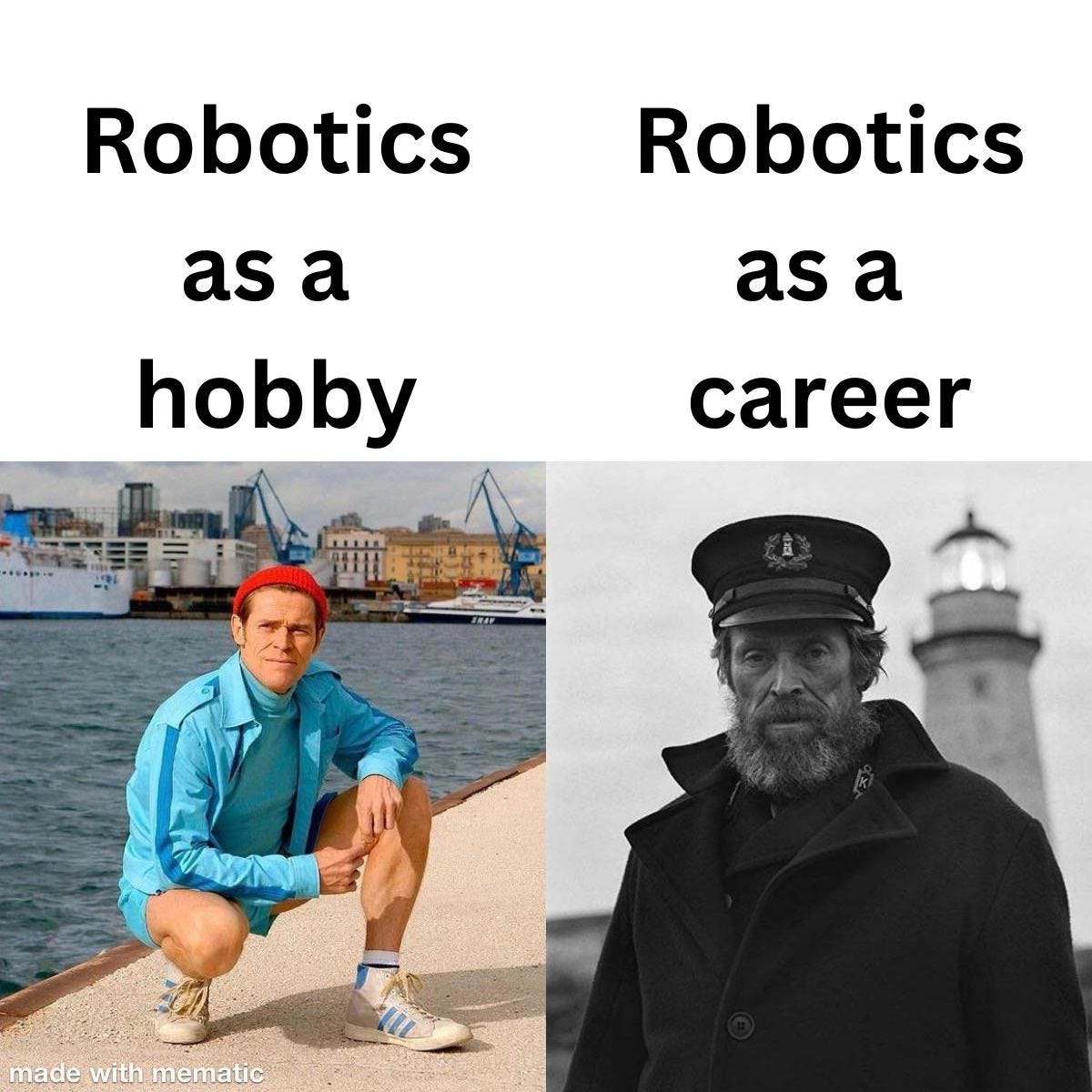
Meme of the week 🤖
Kudos to Aaron Prather, the meme lord in robotics!
Zivid unveils a new, powerful 3D camera 📸
Zivid has unveiled the Zivid 3 XL250, a high-performance 2D+3D vision system built for large industrial robots working in warehouses and factories. Designed for long-range, high-precision perception, the XL250 captures millimeter-accurate 3D data from up to 4.5 meters away, making it ideal for depalletization, truck unloading, and large-bin picking applications.
With a 500 ms capture time and 8 MP RGB+3D resolution, the XL250 delivers crisp, high-fidelity point clouds of entire pallets — including black, shiny, translucent, or highly reflective objects that usually trip up vision systems. Mujin reports the camera helps robots push beyond 99.9% picking performance, even in mixed-SKU environments.
Built with next-generation structured-light projection, the XL250 maintains <0.2% trueness error, generating up to 8 million points per shot. It captures complete 3D geometry in harsh real-world settings thanks to thermal stabilization, eye-safe laser projection, and an IP65-rated aluminum housing that survives drops, vibration, and ambient sunlight from dock doors.
Zivid’s unified 2D+3D approach also simplifies robot cells: barcodes, normals, depth maps, and point clouds all come from a single sensor with integrated flash, eliminating the need for extra cameras or lighting domes. Optimized presets let robots image parcels in 250 ms or full mixed pallets in under 500 ms, supporting high-speed, high-accuracy automation at scale.
More about the new camera here >
Physical Intelligence presents a new VLA! 👓
Physical Intelligence has introduced π*0.6, a major upgrade to its vision-language-action (VLA) model that can learn the way humans do — through instruction, coaching, and real-world practice. The system builds on the company’s π0.6 model but adds a new training method called Recap (Reinforcement Learning with Experience & Corrections via Advantage-conditioned Policies), designed to overcome the classic imitation-learning plateau that limits most robot policies today.
VLAs trained only on demonstrations often succeed some of the time but fail to reach the consistency needed for real deployment. Small mistakes compound, causing robots to drift into states never covered in the training data. Recap tackles this by combining three data sources: human demonstrations, expert corrections (teleoperating the robot when it errs), and reinforcement learning from the robot’s own autonomous experience.
The result is a VLA that dramatically boosts throughput and reliability across complex tasks like making espresso drinks, folding diverse laundry, and assembling real packaging boxes. Physical Intelligence reports that π*0.6 more than doubles throughput on the hardest tasks and cuts failure rates by 2× or more, achieving over 90% success during full-day, uninterrupted runs.
With π*0.6, robots don’t just mimic — they improve. As more robots gather real-world experience, this approach could mark a shift toward autonomous systems that continually refine their skills on the job, unlocking high-speed, high-reliability robotics at scale.
