

What’s inside (version for the busiest people)
RobCo raises $100M Series C, valuation tops $500M
→ German automation startup accelerates US expansion in San Francisco and Austin → Why full-stack platform approach (hardware + software) matters more than point solutions
Bedrock Robotics’ $270M Series B for operator-less excavators
→ Total funding exceeds $350M as company moves toward fully autonomous deployments in 2026
→ What retrofit kits reveal about scaling strategy: leveraging existing fleet infrastructure vs selling new machines
World’s fastest humanoid hits 10 m/s
→ MirrorMe’s Bolt claims speed record with human-like proportions and optimized power system
→ China’s push into robotic athletics gaining momentum since first World Humanoid Robot Games
Carbon Robotics launches first Large Plant Model
→ 150M labeled plants enabling laser weeding adaptation in minutes vs weeks
→ What compounding data flywheel from global LaserWeeder fleet demonstrates about real-world learning loops
LimX Dynamics closes $200M Series B
→ TRON 2’s modular architecture reconfigures limbs between arms and legs without hardware customization
→ Why agentic OS (COSA) combining reasoning with whole-body control matters more than fixed scripts
RobCo raises $100M to expand growing US presence! 🇺🇸
German automation startup RobCo has raised $100 million in a Series C round to advance its physical AI roadmap, expand enterprise deployments, and accelerate its US market presence. The round was led by Lightspeed Venture Partners and Lingotto Innovation (an arm of Exor), with participation from Sequoia Capital, Greenfield Partners, Kindred Capital, Leitmotif, and the Friedkin Group. Bloomberg reported the funding takes the company’s valuation above $500 million.
Founded in 2020 by three researchers at the Technical University of Munich, RobCo develops AI-powered flexible robotic hardware kits for SME manufacturing applications like machine loading, unloading, and palletizing. The Munich-based company builds hardware and software as a single full-stack platform, with robots that can acquire task-specific skills through demonstration and self-learning rather than manual programming, enabling faster deployment and easier adoption.
RobCo expanded into the US in 2025 and currently operates in San Francisco and Austin. The company says the US has become a strategic priority and a major growth market, with manufacturers rapidly adopting automation in response to labor constraints and reshoring initiatives. Co-founder and CEO Roman Hölzl stated the funding will help Robco become the dominant AI robotics company for manufacturing in the US and Europe.
RobCo previously raised $42.5 million in 2024 in a round also led by Lightspeed. Alexander Schmitt from Lightspeed said the firm is excited to double down and co-lead the $100 million round, noting that Robco has continued to raise the standard for what modern robotics can look like in real-world production.
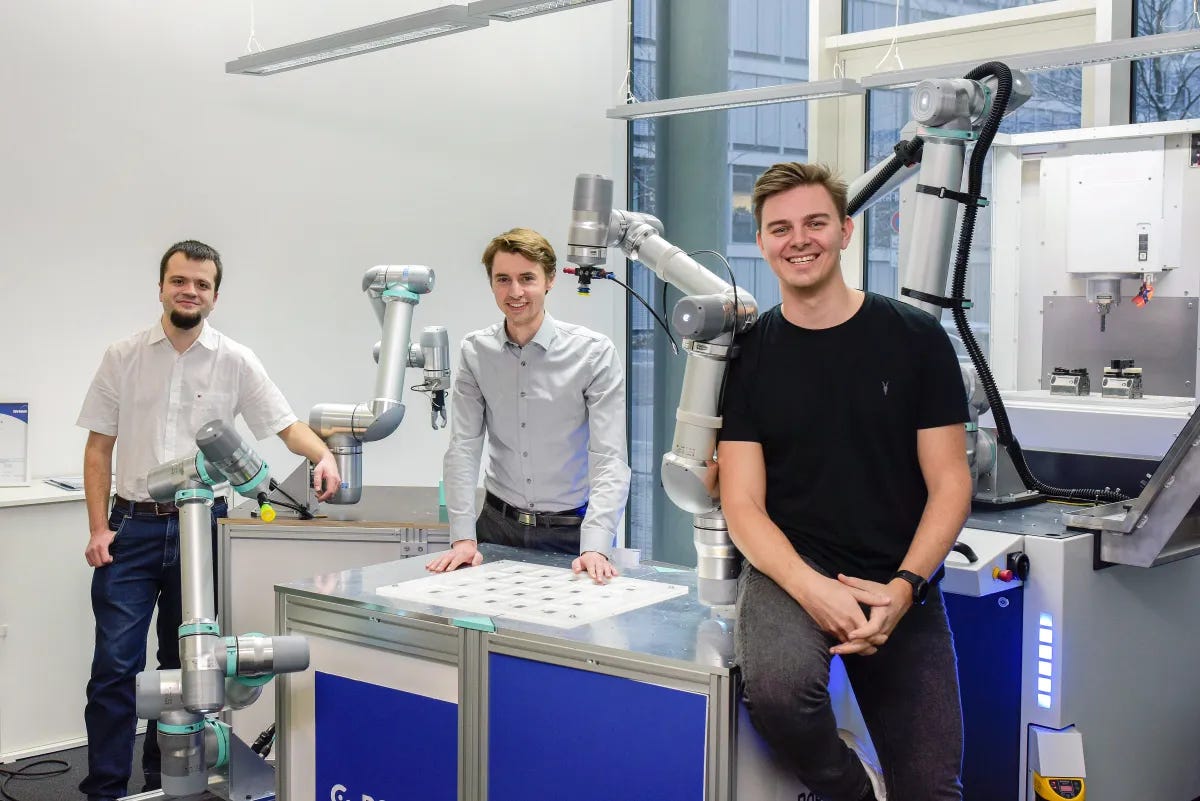
RobCo founders with their modular bots in MunichBedrock Robotics’ $270M Series B to scale the operator-less excavators! 🚜
Bedrock Robotics has raised $270 million in Series B funding, bringing its total funding to over $350 million. The round was led by CapitalG and the Valor Atreides AI Fund, with participation from Xora, 8VC, Eclipse, Emergence Capital, Perry Creek Capital, NVentures (NVIDIA’s venture capital arm), Tishman Speyer, MIT, Georgian, Incharge Capital, C4 Ventures, and others.
The San Francisco-based company emerged from stealth in July 2025 with $80 million in Series A to build retrofit kits for excavators. Co-founder and CEO Boris Sofman, who previously worked at Waymo, told The Robot Report the company is working towards its first fully operator-out, completely operatorless deployments later this year. This marks a major milestone where autonomy capabilities are mature, safety systems are ready, and the company understands the job interfaces needed.
The investment will accelerate Bedrock’s efforts to transform how general contractors build, from deploying individual autonomous machines to orchestrating fully connected fleets. Much of the funding will support data collection, model development, testing, deployment, and expansion of capabilities and volume. The company plans to grow its team and expand its geographical footprint, eventually becoming a giant ecosystem provider by leveraging the existing infrastructure of companies that already buy and manage these machines.
The market opportunity is substantial. McKinsey estimates a cumulative $106 trillion investment is required by 2040 to address global infrastructure needs, while the construction industry needs to attract an estimated 349,000 net new workers in 2026 to meet demand. Bedrock recently expanded its leadership team with Vincent Gonguet as head of evaluation (previously led AI safety for Meta’s Llama models) and John Chu as head of people (former Waymo role overseeing 400% headcount growth).
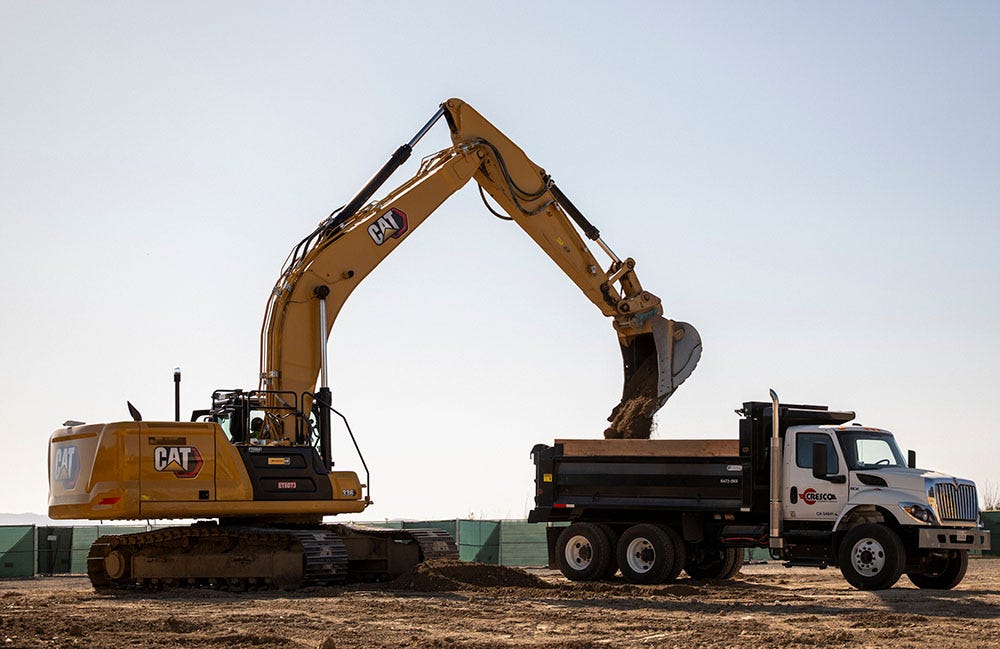
Bedrock Robotics is retrofitting construction machines to be autonomousWorld’s fastest humanoid robot runs 10 meters per second! ⚡
Chinese robotics firm MirrorMe Technology has unveiled Bolt, claiming it as the fastest-running humanoid robot to date with a peak speed of 10 meters per second during real-world testing. The company says Bolt is the first humanoid robot of its size to reach such velocities outside the lab, marking a new benchmark in bipedal robotics.
Standing 175 centimeters (5.7 feet) tall and weighing 75 kilograms (165 pounds), Bolt reflects MirrorMe’s vision of the humanoid robot’s “ideal form,” combining human-like proportions with performance-focused engineering. The robot is built with newly designed joints and a fully optimized power system intended to replicate natural human movement while sustaining extreme speeds. In promotional footage, Bolt took shorter strides than founder Wang Hongtao but compensated with a much faster cadence.
MirrorMe’s goal extends beyond speed records. The company aims to develop “super-species” robots capable of approaching or surpassing human athletic abilities through advanced motion perception and physical performance. Last year, its Black Panther II ran 100 meters in 13.17 seconds on Chinese TV, reportedly outperforming Boston Dynamics in speed tests.
Formally established in May 2024 and headquartered in Shanghai with a core team from Zhejiang University, MirrorMe’s product lineup includes Baobao, Apollo, and Black Panther II, primarily designed for scientific research. The company has treated speed as a long-term priority since 2016, pushing the boundaries of robotic athletic performance. China’s growing focus on robotic athletics was highlighted last August when Beijing hosted the first World Humanoid Robot Games.
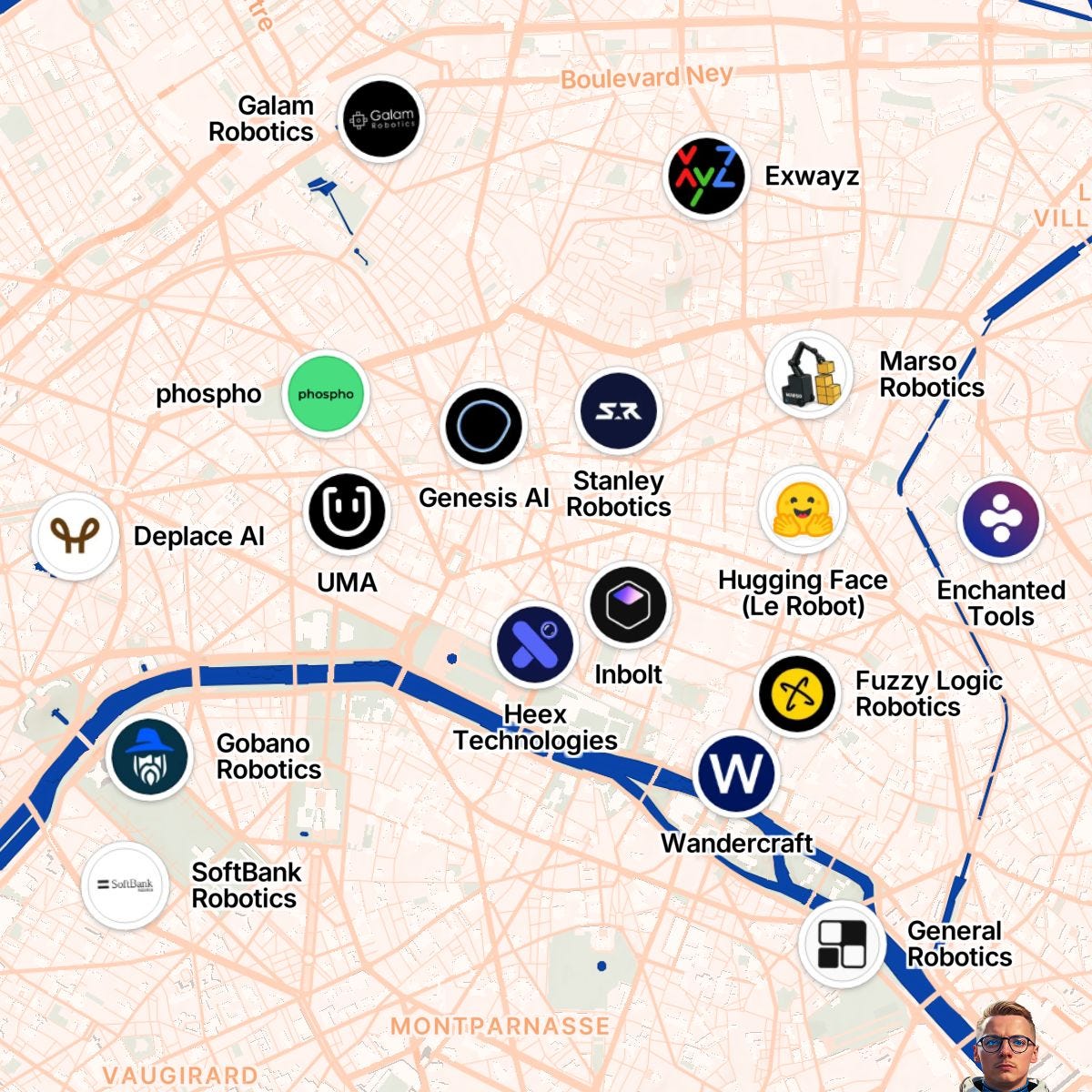
Robotics maps #3 (Paris 🇫🇷)
Paris is emerging as one of Europe’s strongest robotics hubs, mixing world-class tech talent, big startup energy, and strong public support for deep tech. The city has excellent research and engineers from places like Inria (a major robotics and AI research institute) and top schools around Paris/Saclay. This matters because robotics startups often start from research and need smart people who can build real systems.
Paris is one of Europe’s biggest startup hubs thanks to STATION F, one of the world’s largest startup campuses. It gives founders access to mentors, partners, and investors, making it easier to meet the right people fast. France is unusually strong in government-backed deep-tech funding through programs like French Tech 2030 and support from Bpifrance, providing crucial backing for robotics companies that need time and money for prototypes, hardware, and testing.
Key Paris-based robotics companies include Genesis AI (physical-AI lab building generalist robots and foundation models, launched with $105M), Stanley Robotics (robotic valet parking systems), and UMA (general-purpose mobile/humanoid robots for industrial tasks). LeRobot from Hugging Face offers an open-source robotics stack with datasets and models to lower barriers to robot learning, with Pollen Robotics in their portfolio.
Other notable players include Enchanted Tools (friendly humanoid robots like Mirokaï for service environments, ~$17M seed), Fuzzy Logic Robotics (quick robot programming platform, €2.5M seed), and Inbolt (real-time 3D vision guidance for industrial arms, ~$16-17M Series A). Heex Technologies builds smart data software for edge AI (€6M seed), while Wandercraft develops robotic exoskeletons and humanoid R&D ($75M total funding). SoftBank Robotics EMEA HQ commercializes service robots like Pepper and NAO, Galam Robotics builds modular warehouse automation (€10M Series A), Exwayz develops GPS-free 3D localization for autonomous robots (€1M), and phospho (YC W24) builds tools to connect, control, and train AI models on robots.
Carbon Robotics launches the world’s first-ever Large Plant Model! 🌱
Carbon Robotics has announced a major breakthrough with the launch of the world’s first Large Plant Model (LPM), the most advanced AI model for plant detection and identification. Trained on the largest, most diverse, and fastest growing agricultural dataset ever built with 150 million labeled plants, the LPM enables farmers to start laser weeding any field or crop in minutes.
The LPM serves as the foundation for Carbon AI, the decision-making brain operating across all Carbon Robotics products. As the company’s global LaserWeeder fleet operates in fields daily, the system continuously ingests real-world data in a compounding data flywheel effect, strengthening the model exponentially and improving performance for all LaserWeeders worldwide. Trained on diverse crops, weeds, soil types, climates, and growth stages, the LPM creates an unprecedented foundation for plant recognition and decision making.
A new feature called Plant Profiles demonstrates how this AI translates into practical value. It enables farmers to quickly tailor the foundational LPM to their unique crops, weeds, and field conditions. Operators can select just two to three images in the iPad Operator App to add to their Plant Profile and the system immediately adapts, optimizing LaserWeeder behavior for their specific fields. Unlike other AI-based systems that require substantial farmer input and take weeks or months to create new models, Plant Profiles enables adaptation in minutes.
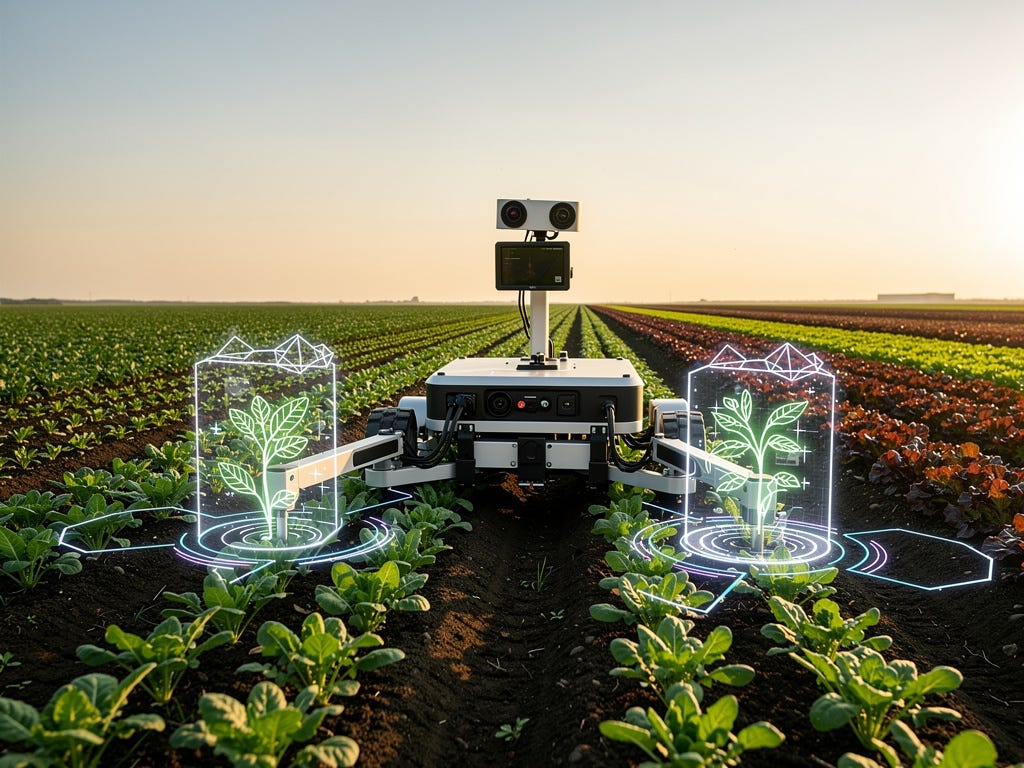
Carbon Robotics introduced a large model for plantsLimX Dynamics picks up $200M for expansion! 💸
LimX Dynamics has completed a $200 million Series B financing round to accelerate research and development and market expansion with new and existing shareholders, plus ecosystem partners. The Shenzhen-based company, founded in 2022, is developing full-size humanoid robots and embodied AI with a mission of bringing artificial general intelligence into the real world, focusing on robot hardware design and manufacturing, motion-control foundation models, and a physical-world-native agentic OS.
LimX said its TRON 2 and LimX COSA systems have attracted industry attention in recent months. Thanks to its modular architecture, TRON 2 can be reconfigured to use its limbs as manipulator arms or legs for walking. Unveiled in December 2025, this unified design allows developers and industry users to adapt the robot to different applications without customizing hardware for individual tasks, serving as a reusable, scalable, and continuously evolving robotic foundational platform.
LimX COSA is an agentic operating system developed from the ground up for robots to function in the physical world. The company says it combines high-level reasoning and decision-making with whole-body motion control. With COSA, the Oli humanoid no longer relies on fixed scripts. Instead, the OS orchestrates models, skills, and hardware as a unified system, enabling robots to autonomously execute complex tasks by interpreting instructions, perceiving surroundings, planning actions, and adjusting behaviors in real time to handle dynamic environments.
Leading Chinese and international investors joined the Series B round, including Stone Venture, JD, Oriental Fortune Capital, and CoStone Capital. Shangqi Capital (backed by SAIC Motor), NIO Capital, Future Capital, and other existing shareholders also participated in the round.
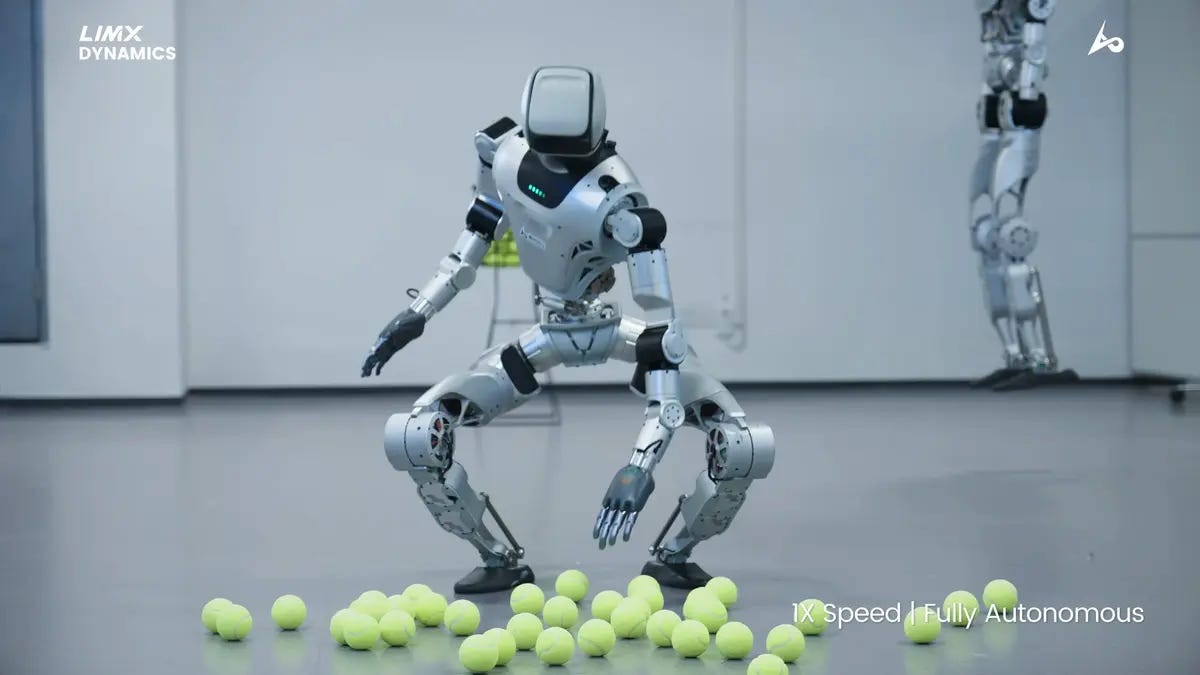
LimX Dynamics humanoid picking up tennis balls