
EP.94 BMW DEPLOYS HUMANOID ROBOTS IN EUROPE
Wayve raises $1.2B Series D, Unitree Robotics unveils their newest robot dog & much more...

What’s inside (version for the busiest people)
BMW deploys humanoid robots in Europe for first time
→ Hexagon’s AEON tested at Leipzig plant for high-voltage battery assembly and EV production
→ Why April 2026 broader test and summer pilot signal shift from lab to stable shift operation
RLWRLD raises $26M, total seed hits $42M
→ Physical AI foundation models trained on real factory/warehouse data vs clean lab settings
→ What multimodal data from unpredictable live operations reveals about simulation limitations
Wayve closes $1.2B Series D at $8.6B valuation
→ End-to-end AI Driver runs entirely onboard, zero-shot deployment in 500+ cities across 70 countries
→ Why licensing to automakers vs vertical integration matters for capital-light scaling
Unitree unveils As2 quadruped robot
→ 5 m/s top speed, 4+ hour runtime unloaded, 20 km range with 648Wh battery
→ What 90 N·m joint torque and 5 N·m/kg torque-to-weight ratio demonstrate for payload strength
BMW deploys humanoid robots in Europe for the first time! 🇪🇺
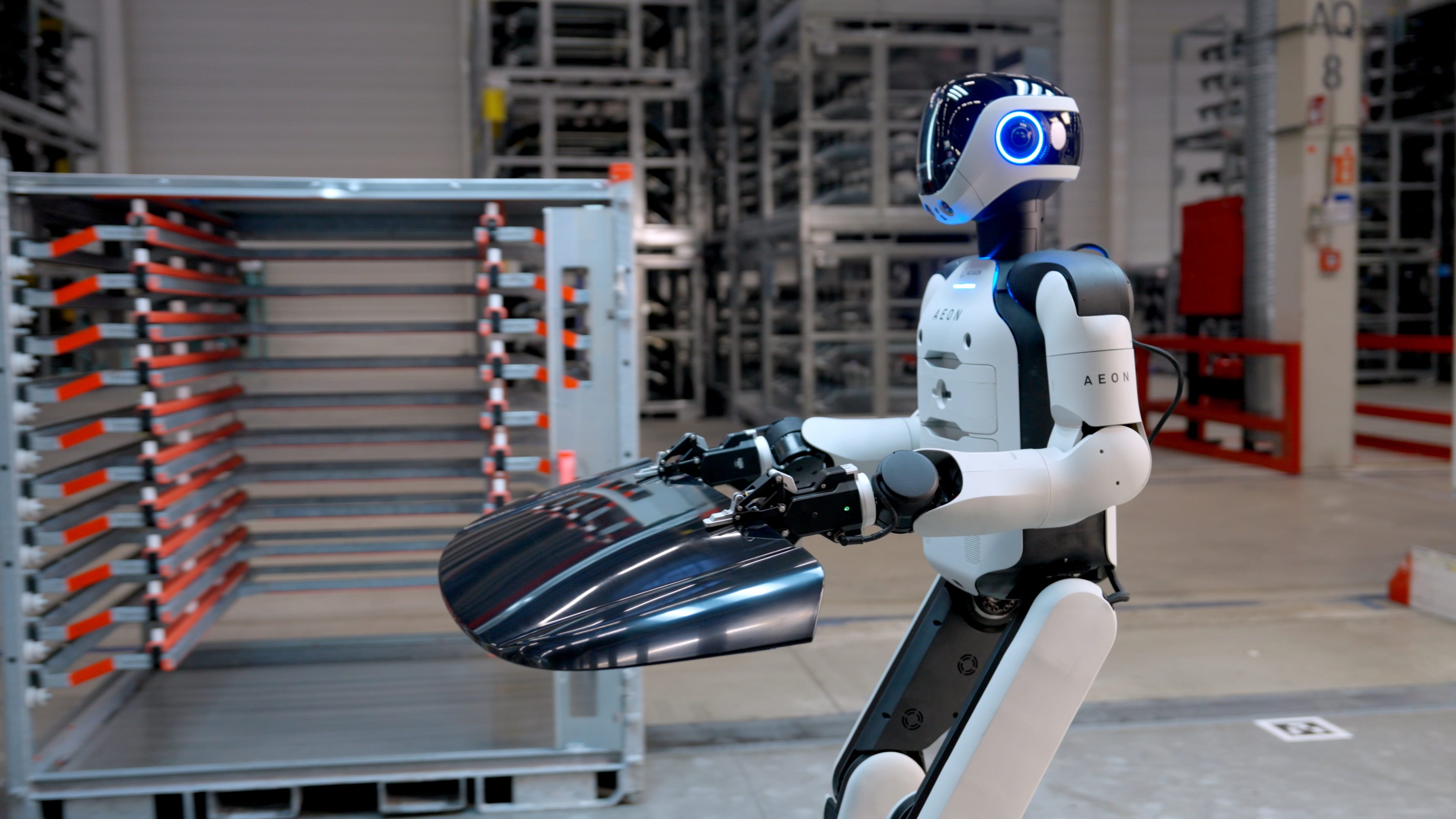
BMW is placing humanoid robots on the factory line at its Leipzig plant, marking the first time the company has deployed them at a European facility. A small fleet of Hexagon Robotics humanoids is being tested on assembly lines and in high-voltage battery production for electric vehicles, an area where employees currently wear cumbersome protective gear. A broader test deployment is planned for April 2026, with a full-scale pilot launching in summer 2026.
Hexagon’s humanoid, AEON (unveiled in June 2025), features a human-like body that can accommodate various hand, gripper, and scanning attachments, and moves dynamically on wheels. The Leipzig pilot began in December 2025, focusing on high-voltage battery assembly and component manufacturing where precision, safety, and ergonomics are critical. BMW explicitly positions humanoid robotics as a complement to existing automation, not a replacement for workers, aiming to “relieve employees and further improve working conditions” in repetitive or physically taxing roles.
BMW’s production chief Milan Nedeljković, set to become CEO in May, emphasized that the symbiosis of engineering expertise and artificial intelligence opens up entirely new possibilities in production. BMW calls this “Physical AI”—intelligent systems that perceive, reason, and act within complex, real-world manufacturing environments. According to Michael Ströbel, BMW’s head of process management, humanoids could eventually allow BMW to bring work in-house that currently goes to suppliers.
The Leipzig pilot builds on lessons from Spartanburg, South Carolina, where Figure AI’s Figure 02 robot worked daily ten-hour shifts for ten months in 2025, supporting production of over 30,000 BMW X3s. The robot handled precise removal and positioning of sheet metal parts for welding, moving over 90,000 components, logging roughly 1,250 operating hours, and covering approximately 1.2 million steps. The transition from lab to production floor happened faster than expected, with motion sequences transferring smoothly into stable shift operation.
BMW deployed first humanoid robots in Europe!Physical AI startup RLWRLD raises $26M! 🤖
RLWRLD, a physical AI startup developing robot foundation models for industrial environments, has raised $26 million in Seed 2 funding. This brings the Seoul-based company’s total seed capital to $42 million, following its $14.8 million Seed 1 round in April 2025. The round was led by global venture firm Headline Asia and Z Ventures (the corporate venture capital arm of Z Holdings and Yahoo Japan–LINE), with participation from strategic investors including CJ Logistics, Kakao Investment, Lotte Ventures, Hanwha Asset Management, and Mirae Asset–Emart Investment Fund.
Unlike robotics systems trained primarily in clean, controlled lab settings, RLWRLD’s models are trained using high-precision, multimodal data collected directly inside real factories, warehouses, and service environments. The company exposes its models to the unpredictability of live operations, crowded spaces, variable lighting, human interaction, and imperfect conditions, that are difficult to replicate in simulations. RLWRLD’s scalable, multi-sensor system captures complex demonstrations from diverse industrial settings, generating rich data for robust, adaptable models.
RLWRLD is executing proof-of-concept and robotics transformation projects with enterprise partners across logistics, retail, and service environments in Japan and South Korea. Several initiatives with major companies, including CJ Logistics and Lotte, have progressed from memoranda of understanding (MOUs) into joint industrial validation phases. The company is actively working with multiple strategic investors on joint projects that include using real-world operational data to train and validate its models.
Wayve raises $1.2B with plans to bring robotaxis to London! 🚖
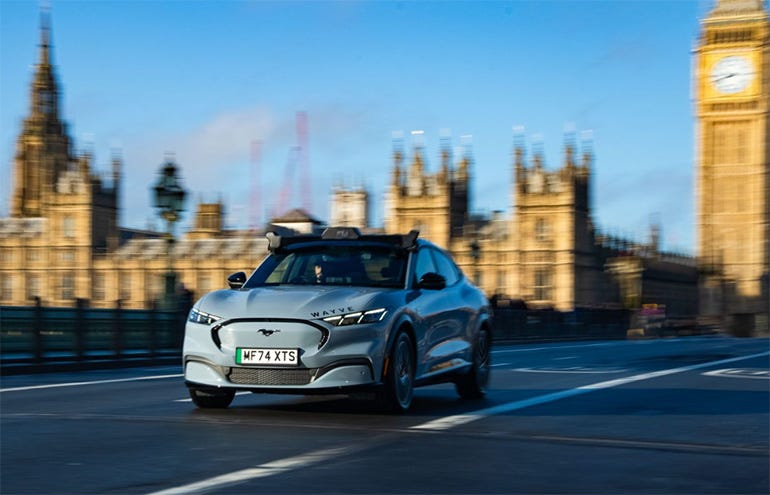
Wayve Technologies has closed a Series D round of $1.2 billion, bringing its post-money valuation to $8.6 billion. The London-based company plans to use the funding to accelerate commercialization of its end-to-end AI platform for autonomous driving.
Founded in 2017, Wayve’s AI Driver doesn’t rely on deterministic, map-based systems and runs entirely on onboard vehicle compute. The unified AI platform spans SAE Level 2 “hands-off” operations through Level 4 “eyes-off” driving across vehicles, brands, and markets. The company’s AV2.0 foundation model replaces the “sense-plan-act” architecture with a single neural network, trained on data from over 70 countries and a wide range of vehicles for easier generalization to new markets.
Wayve claims to be the first and only AV developer to drive zero-shot in more than 500 cities across Europe, North America, and Japan, meaning without city-specific fine-tuning before deployment. The company licenses its software directly to automakers, providing tools to customize driving models for specific vehicles and brands. By partnering with manufacturers and mobility platforms rather than vertically integrating, Wayve asserts its approach enables autonomous vehicle technology to scale globally with lower capital intensity.
This year, Wayve plans to conduct robotaxi trials with Uber (a past and current investor) in London. Under the partnership, Wayve will deploy its AI Driver in L4-capable vehicles from participating automakers, while Uber will own and operate the fleet. In 2027, consumers will be able to buy AI Driver-equipped passenger vehicles, starting with L2+ capability that allows the vehicle to steer, navigate, and respond to traffic under driver supervision.
Robotics maps #5 (Odense 🇩🇰)
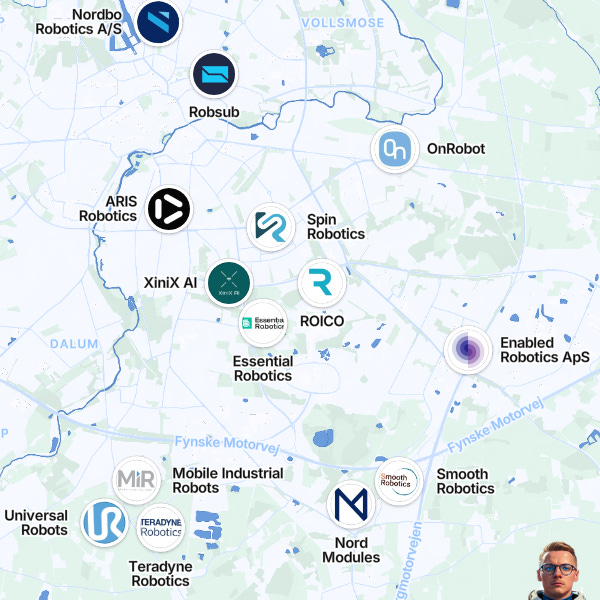
Odense is one of Europe’s strongest robotics ecosystems, especially for collaborative and industrial robots. At the center is Syddansk Universitet (University of Southern Denmark/SDU), which has a leading robotics research department and works closely with startups. Many founders and engineers come directly from SDU labs, making it easy to turn research into real companies.
A major boost came from the success and acquisitions of Universal Robots and Mobile Industrial Robots. Their global growth and later acquisitions created serial founders and angel investors, capital recycled back into new startups, and a strong global reputation for Odense robotics. Startup support initiatives like Odense Robotics help with global commercialization and partnerships, allowing more robotics startups to be incubated locally with support from experienced mentors who have already built and scaled global robot companies.
Key Odense-based companies include Universal Robots (collaborative robotic arms, acquired by Teradyne for ~$285M), Mobile Industrial Robots/MiR (autonomous mobile robots for internal logistics, acquired by Teradyne for ~$148M), and Teradyne Robotics (Teradyne’s robotics division). OnRobot provides plug-and-play end-of-arm tooling for collaborative robots (~$55M+ raised), while ROICO develops robotic solutions for industrial painting applications.
Other notable players include Spin Robotics (collaborative robot torque tools for automated screwdriving), Enabled Robotics (mobile manipulator robots for flexible logistics automation), Nord Modules (modular top modules for AMRs to expand logistics functionality), and Smooth Robotics (automated welding solutions for cobots). Essential Robotics builds autonomous healthcare solutions, XiniX AI develops AI software and vision for robotics, ARIS Robotics creates advanced robotic systems for industrial and research applications, RobSub builds underwater robotic systems and ROVs for marine applications, and Nordbo Robotics develops force-torque sensor technology and adaptive control software for robots.
Unitree Robotics revealed their new robot dog! 🐕
Chinese robotics firm Unitree Robotics has unveiled the As2, a high-performance quadruped robot built for speed, payload strength, and advanced autonomous capabilities. Weighing about 18 kg (40 pounds) with its battery, the robot delivers up to 90 N·m of maximum joint torque and can reach running speeds above 5 meters per second (approximately 11 mph).
The As2 is powered by a 648Wh, 15,000mAh lithium battery that allows more than four hours of runtime when unloaded, covering distances beyond 20 km (12.4 miles). Even when carrying a 33 lbs load, it maintains more than 2.5 hours of operation with a walking range exceeding 13 km (8.08 miles). Designed for real-world environments, the robot carries an IP54 rating for dust and rain resistance and can operate in temperatures from -20°C (-4°F) to 50°C (122°F).
The quadruped demonstrates impressive mobility metrics. It can climb 25 cm stairs, handle slopes up to 40 degrees, and mount vertical platforms as high as 50 cm. Maximum continuous walking load reaches around 15 kg (33 pounds), while its standing payload capacity goes up to 65 kg (143 pounds) in the EDU variant. Speed varies by model: the As2 AIR runs between 0 and 3.0 m/s, while the PRO and EDU versions reach 3.7 m/s, with peak speeds approaching 5 m/s under no-load conditions.
Mechanically, the As2 features 12 degrees of freedom driven by low-inertia, high-speed inner rotor PMSM motors with industrial-grade crossed roller bearings for high precision and load capacity. The torque-to-weight ratio stands at approximately 5 N·m/kg, enabling powerful yet agile motion. The robot integrates dual encoders for each joint, local air cooling, supply voltage from 36V to 50.4V, plus Wi-Fi 6, Bluetooth 5.2, speaker, microphone, front light, and HD camera across all versions.
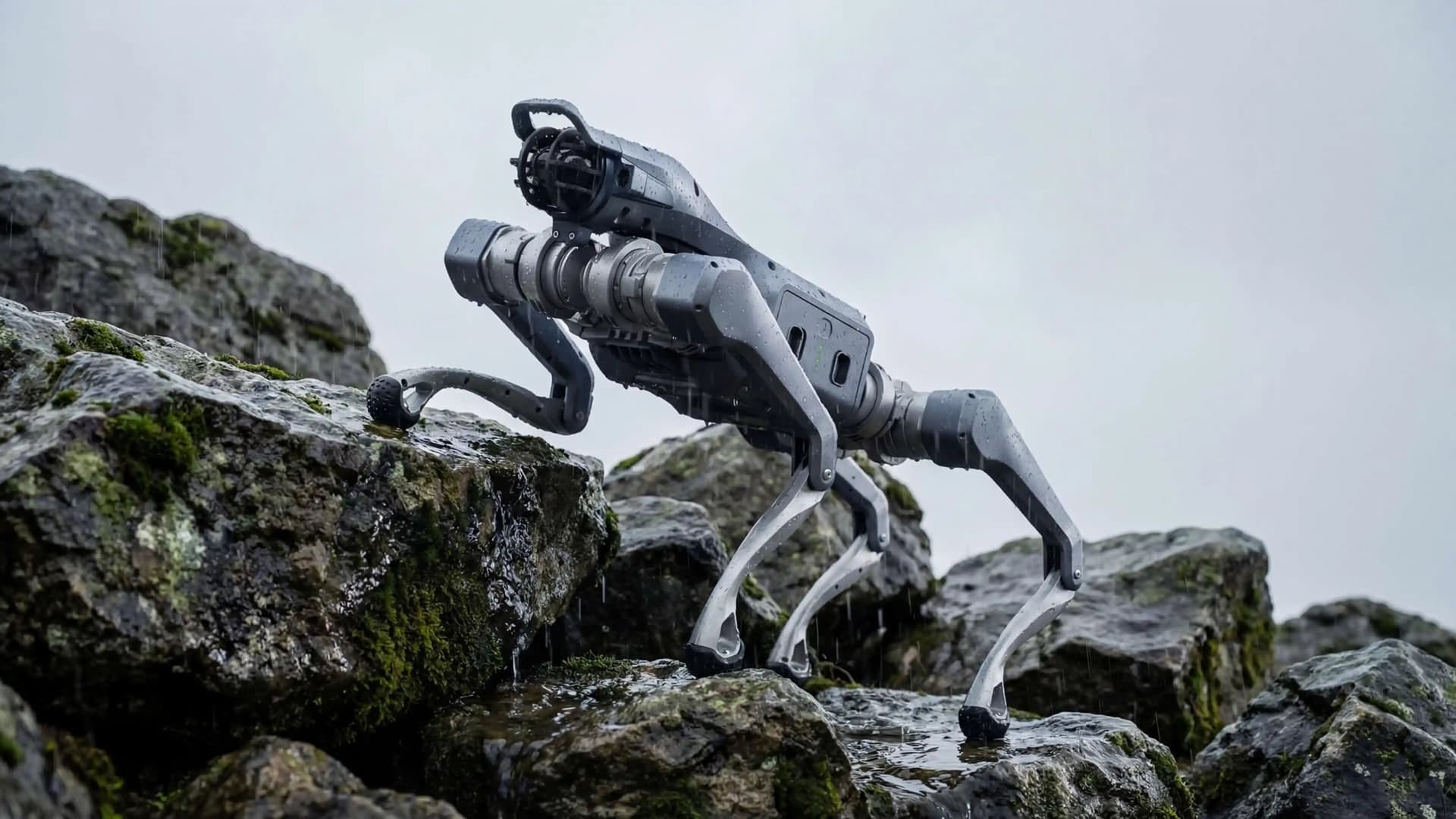
Newest addition to Unitree Robotics family